The Unfulfilled Electoral Potential of West European Liberal Parties
My new book, published by Oxford University Press, is now out in both online and print formats. If you don’t have access to the book but would like to read an electronic copy, please get in touch and I’d be happy to help!
In The Unfulfilled Electoral Potential of West European Liberal Parties, I argue that while liberal parties struggled to maintain popular support throughout much of the twentieth century, recent changes in the structure of voter preferences appear to offer these parties a route to much greater success. Specifically, I find that growing numbers of voters combine pro-market attitudes on economic issues (e.g. taxes, social spending) with cosmopolitan and progressive attitudes on cultural issues (e.g. immigration, European integration). These ‘market cosmopolitan’ positions do not fit well with the ideology of traditionally dominant centre-left or centre-right parties, nor the insurgent radical left or radical right; instead, they are shared exclusively by (most) liberal parties, whom I term ‘social liberals’.Theoretically, this appears to represent a major opportunity for social liberal parties: increasing numbers of voters share their ideological positions on both economic and cultural issues, and none of their major rivals should be able to offer direct competition in this space. If, as is generally well-established, voters tend to support parties that best represent their own positions, then there should be little to prevent social liberals from gaining the support for these market cosmopolitans. However, in most cases, this has not resulted in breakthroughs for social liberal parties. If we map voters and parties in this two-dimensional ideological space, and expect voters to opt for the party that best matches their ideological position, social liberals should out-perform all other party groupings. However, in practice, they heavily under-perform relative to their favourable positions: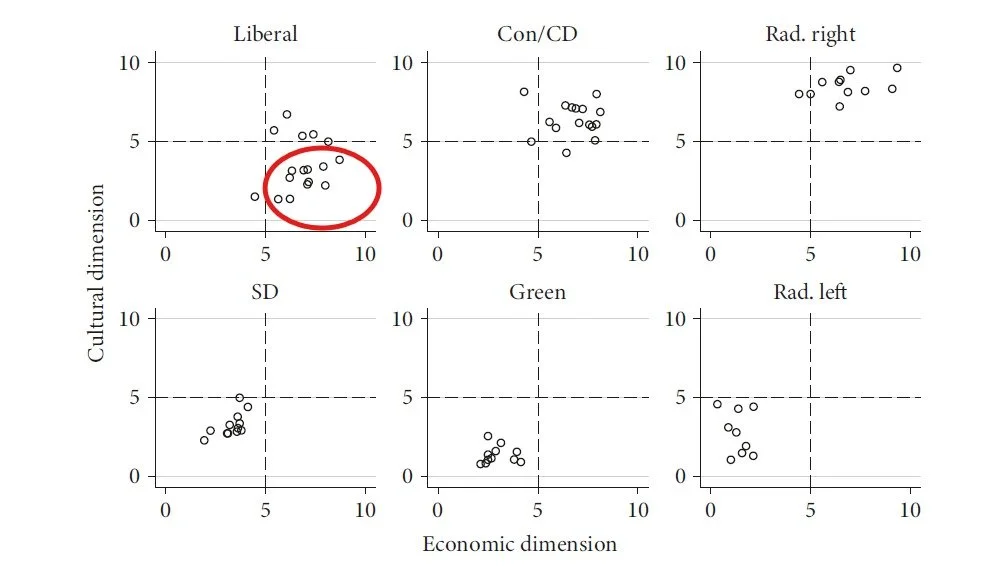
Expert data suggests that only liberal parties occupy the market cosmopolitan (bottom-right) ideological quadrant. The other major party groupings are largely confined to the traditional left (bottom-left) or traditional right (top-right) quadrants. (Source: Chapel Hill Expert Survey 2019).
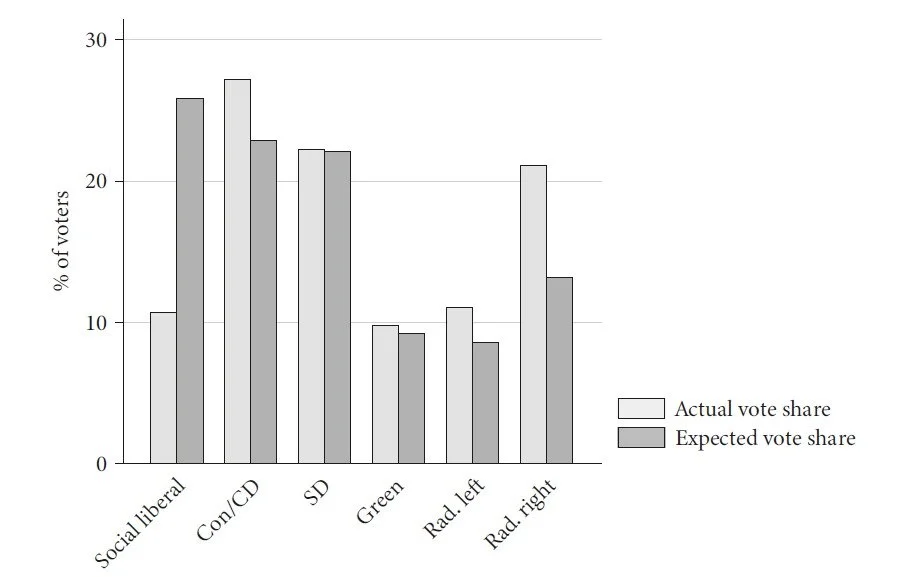
Combining data on voter and party positions suggests that social liberal parties are the best ideological match for a large portion of voters (expected vote share), but win relatively little electoral support in practice (actual vote share). (Sources: European Election Study 2019; Chapel Hill Expert Survey 2019).
As I argue, this represents a clear research puzzle. In spite of the wealth of evidence that voters vote for parties close to their own ideological positions, these market cosmopolitan voters overlook the parties that clearly represent their closest ideological match, in favour of much less compatible alternatives. Indeed, using spatial voting models, I find two-dimensional ideological distance to be considerably less influential in guiding the vote choices of market cosmopolitans than the rest of the electorate. This puzzle is made even more striking by the fact that market cosmopolitan voters are comparatively well-educated and politically aware, meaning that they should be among the most capable of all voters of identifying the parties that best represent their own preferences, and voting accordingly.To explain this puzzle, I develop and test theories at both the party level and the voter level. At the party level, I find some evidence that social liberal support is undermined by these parties’ non-ideological reputations among voters, potentially leading market cosmopolitans to favour parties they consider to be more ‘competent’. More importantly, however, at the voter level I find evidence that market cosmopolitans are swayed by existing partisan ties which appear to pre-date their market cosmopolitan positioning (and therefore their proximity to social liberal parties). In fact, given that more politically engaged voters are less likely to switch parties between elections, market cosmopolitans’ high levels of political knowledge and interest appear to have encouraged them to stick with their usual parties and therefore overlook social liberals despite their evident compatibility. In other words, being politically aware seems to make these voters less likely to vote in line with their ideological preferences.However, social liberals’ failure to win over these voters thus far certainly does not rule out any future successes. The book concludes by noting that as young market cosmopolitans come of voting age, they may lack these pre-existing partisan ties to parties that do not share their ideological positions. What is more, even market cosmopolitan voters that have remained loyal to parties of the traditional left and right may see this loyalty begin to waver, particularly where these parties are seen as accommodating the radical right by taking up more nationalist positions on issues such as immigration. In such circumstances, social liberals should be in a strong position to increase their support, provided they can cultivate a reputation for competence in the eyes of these voters. It remains plausible, then, that social liberals can begin to fulfil their electoral potential.